
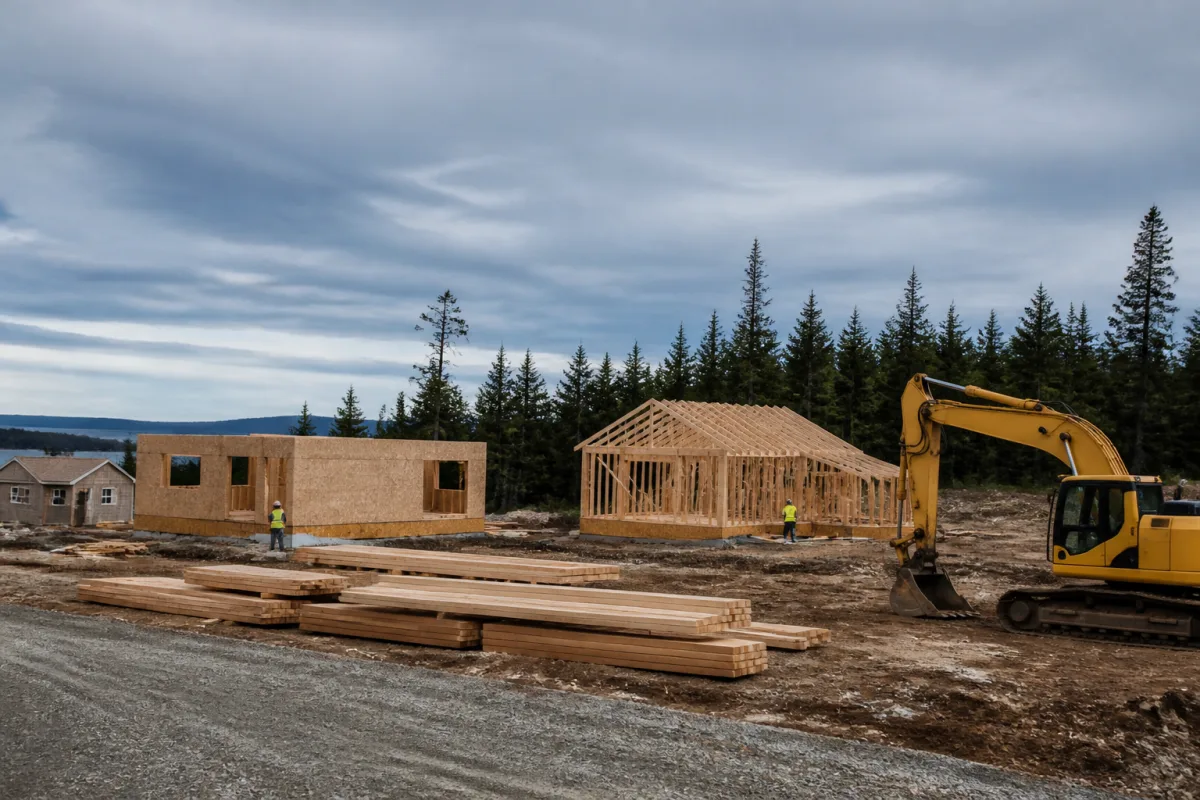

Nova Scotia runs its own immigration stream for 22 construction trades, letting workers get Canadian permanent residence if they have a job offer, verified experience, the right education, and English or French at the required level.
In short
- This program is a separate stream within the Nova Scotia Nominee Program, covering 22 construction trades under the Construction category.
- Applicants must be between 21 and 55 years old inclusive, with completed secondary school or a construction-specific trade certificate.
- At least 1 year of official work experience in the specific job is required — unofficial work and reference letters don’t count as proof.
- Language is confirmed by test: CLB 5+ for NOC 0-3 and CLB 4+ for NOC 4-5.
- Relocation, flights, consultants, and government fees are entirely self-funded — the province doesn’t cover these costs.
What the Nova Scotia construction pathway is
This pathway sits at the provincial level, not the federal one — Nova Scotia created it, and applications go through the province, not Ottawa. Canada runs federal immigration programs alongside separate programs run by each province, and across the country there are roughly 150 of these programs combined. If the Nova Scotia pathway doesn’t fit a given applicant, other provincial and federal options still remain open.
Structurally, this is a dedicated category inside the Nova Scotia Nominee Program’s Skilled Worker stream — carved out for a specific labor market niche. Provinces create these targeted categories around a single occupational group, or sometimes around relocation to particular small towns. In Nova Scotia’s case, the niche is construction: the province has active, growing housing construction, and it set up this stream specifically to fill the labor shortage in that sector.
The list of 22 construction trades covered by the program
List of construction trades covered by the program
The program’s list covers trades tied to residential and commercial building construction, along with related work:
- heavy construction equipment operators;
- material handlers and warehouse workers on construction sites;
- construction laborers.
This isn’t an arbitrary mix: the program is limited to a specific list of occupations under the Construction category, and an application is only considered if the applicant’s position is on that list. To qualify, the job offer from a Nova Scotia employer must correspond to one of the listed trades — without that match, an application under this pathway isn’t reviewed at all.
An application is reviewed only if the job offer corresponds to one of the Construction category trades included on the program’s list.
Age and education requirements
Applicants must be between 21 and 55 years old inclusive. If an applicant is under 21 or already past 55, they cannot apply under this pathway.
Education can be confirmed in one of two ways.
- Completed secondary school. That means either 11 years of schooling, or 9 years plus college.
- Construction-specific trade training. A document showing completion of training in a construction trade also qualifies — for example, a welding or electrical certificate that authorizes the holder to work in that trade. If an applicant has 9 years of schooling plus such a certificate in a trade included on the program’s list, that combination can also serve as proof of education.
The age and education requirements come from the Government of Canada’s official information pages, but exactly how they’re applied when a specific application is assessed is a matter of case-by-case adjudication, not just the wording of the rule.
What’s needed to qualify for the program
What level of English or French the Nova Scotia program requires
English or French proficiency is confirmed through a language test — for example, CELPIP or PTE General for English, with separate tests available for French. The required level depends on the National Occupational Classification (NOC) category your trade falls under.
For NOC categories 0, 1, 2, or 3, applicants need a Canadian Language Benchmark (CLB) of at least 5. The NOC code for a specific occupation is found on the Government of Canada’s official page for this classification system.
For simpler occupations in NOC categories 4 or 5, CLB 4 is enough — this is the lowest passing level found in any Canadian immigration program. No immigration program sets a requirement below CLB 4, with the exception of spousal sponsorship.
The highest level on the CLB scale is 10, corresponding to native-speaker fluency, but no active immigration program requires that level.
How NOC categories map to CLB levels
| NOC Category | Required CLB Level |
|---|---|
| 0, 1, 2, 3 | at least 5 |
| 4, 5 | at least 4 |
Required language level by NOC category
The minimum CLB level depends on the occupation’s category under the NOC classification system.
- NOC Categories 0, 1, 2, 3CLB at least 5
- NOC Categories 4, 5CLB at least 4
Job offer and work experience in a construction trade
To participate in the program, applicants need a full-time, permanent job offer from a Nova Scotia employer operating in the construction sector — without it, there’s no application to make. The job must correspond to one of the trades on the program’s list.
Beyond the job offer, applicants must confirm at least one year of experience in that trade, tied to the intended position. If the job offer is for a welder, the applicant needs to confirm a year of work specifically as a welder, not experience in a related trade.
Only official experience counts — meaning work on which taxes were paid. Unofficial, under-the-table work doesn’t qualify for the program, and it can’t be confirmed through a reference letter from an employer: that kind of document doesn’t replace formal employment and isn’t accepted as proof of experience.
Only official experience counts — meaning work on which taxes were paid.
Experience must be official, with taxes paid. Unofficial work and employer reference letters don’t confirm experience.
Financial requirements and who pays for relocation
The government doesn’t cover relocation or its related costs — this needs to be budgeted for separately from the job and experience requirements. To participate in the program, applicants must show sufficient funds to cover relocation, settling in, and living in Nova Scotia.
The province helps with paperwork, but it doesn’t fund the move itself: applicants pay for their own flights to Nova Scotia. The same goes for all immigration-related costs — immigration consultant fees and government fees. The state doesn’t cover any part of these expenses: participating in the program assumes the applicant can support themselves from the moment they arrive, rather than relying on provincial support.
participating in the program assumes the applicant can support themselves from the moment they arrive, rather than relying on provincial support
The province helps with paperwork but doesn’t pay for flights, consultant fees, or government fees — applicants cover all of this themselves.
How long processing takes under the Nova Scotia program
The province doesn’t publish exact official processing times for this pathway, and applicants’ real experiences vary widely. Many applicants report long waits with no explanation: some go months without a response, while others see their review drag on without any reason given.
There are also cases of fast processing — but it would be a mistake to assume that’s what everyone can expect: that’s a classic survivorship bias, where a handful of lucky outcomes get treated as the general rule.
that’s a classic survivorship bias, where a handful of lucky outcomes get treated as the general rule
The spread in processing times comes down to how Canada’s immigration service actually operates: it’s an institution staffed by people, and document processing can take a long time without any visible pattern. In practice, this means applicants under this pathway should expect a long and not always predictable wait, and should build in extra time for this part of the process.
There’s no official processing timeline and outcomes vary widely — plan relocation and other steps with a buffer for a long, unpredictable wait.
Frequently asked questions
What if my trade isn’t on the list of 22 construction occupations covered by the program?
If your position isn’t on the program’s list, an application under the Nova Scotia Nominee Program’s construction stream won’t be considered. Other options remain available — other provincial programs in Canada, or federal programs, which together number roughly 150 across the country.
Can I take the language test later, after already getting a job offer?
Based on the program’s requirements, confirming language through a test such as CELPIP or PTE General is a separate, mandatory condition alongside the job offer, age, education, and experience requirements. The order in which these steps need to be completed isn’t specified, but each one has to be satisfied before applying.


Comments
Reader experience is useful, but it is not advice: check the rules on the official site.
No account needed: click Sign in, type any name, and you are done.