


A USCIS officer expects to see a body of evidence of shared life and finances — photos spanning a long period, proof of joint trips, shared accounts and documents — and the decision on an I-130 petition is based on the whole picture together with the couple’s behavior at the interview.
In short
- An officer decides on an I-130 petition based on the totality of the circumstances, not one document.
- A marriage interview lasts 20–40 minutes, and inconsistencies in the spouses’ story stand out immediately.
- Missing a joint lease, joint accounts, or a matching address on a license doesn’t by itself suggest a sham marriage.
- Unique evidence — contractor correspondence, medical agreements, a stepparent’s role — is harder to fake than the standard package of photos and accounts.
- Marriage fraud for a green card carries a penalty of up to 5 years in prison.
A Marriage Fraud Case: How the Simulation Looked
On October 19, USCIS published a press release about a marriage fraud case: a U.S. citizen named Chen and an accomplice submitted false information to obtain a green card and other immigration benefits for the accomplice. According to the allegations, Chen agreed to receive partial payment at each stage of the green card process.
What stood out in the case wasn’t the fraud itself but how thoroughly it was staged. Chen and the accomplice discussed a fabricated story of an online romance and a long-distance relationship — including how they supposedly met and who introduced them. They planned a prenuptial agreement and the opening of joint accounts: a bank account, a shared phone plan, insurance, and a discount-store membership — everything that in practice looks like running a shared household.
They planned a prenuptial agreement and the opening of joint accounts: a bank account, a shared phone plan, insurance, and a discount-store membership — everything that in practice looks like running a shared household.
The couple filed a notice of intent to marry in Quincy. Before the ceremony, Chen had the accomplice buy a cheap fake diamond ring. After the wedding, Chen arranged to file Form I-130 — the petition for an alien relative meant to document the claimed marital relationship and open the path to a green card for the accomplice.
The defendant faces up to 5 years in prison; until sentencing, he is presumed innocent.
USCIS uncovered a sham marriage scheme where a couple meticulously staged a real relationship — from an online romance to joint accounts. The defendant faces up to 5 years in prison.
What an Officer Expects to See in a Marriage Case
When reviewing an I-130 petition, an officer looks for evidence of cohabitation and shared finances: photos, joint insurance documents, joint bank accounts. This is the basic package that gets checked first.
The problem is that the same package shows up just as often in fraudulent cases — sometimes even more complete than in real couples’ files, who simply never thought about opening a joint account or a shared phone plan. Because of this, some USCIS officers approach marriage cases with built-in skepticism: fraudulent files sometimes contain more documents than genuine ones, and that raises the evidentiary bar for every applicant.
fraudulent files sometimes contain more documents than genuine ones, and that raises the evidentiary bar for every applicant
Fraudulent files sometimes look better documented than genuine ones. As a result, officers approach even honest couples with more skepticism.
Missing a Lease, Joint Accounts, or a Matching Address
Not having a joint lease doesn’t by itself suggest a sham marriage: real couples sometimes live with relatives and therefore aren’t named on a separate lease. The same goes for joint accounts — spouses may not open them because of limited income, past financial trouble, or simply because they never thought about combining assets.
A separate complication is an outdated address on a driver’s license: if one spouse hasn’t updated the document after moving, the couple can’t formally use it to prove they live together. This isn’t an exception — it’s one of the typical situations genuine married couples run into while gathering evidence for the petition.

Missing a joint lease, joint accounts, or a matching address on a license doesn’t prove fraud — it’s a common situation for genuine couples too.
Photos and a Timeline in Google Docs
Photos with friends and family taken over a long period are one of the strongest arguments in a marriage case: faking such a series of photos is far harder than forging a single document.
- Gather all the photos from the entire relationship — there can be 2,000 of them; there’s no limit.
- Arrange the photos in Google Docs in chronological order, from the earliest to the most recent.
- Under each photo, add a short description: who is in it, when and where it was taken, and whether it was a special occasion. No need for a full paragraph — 5 to 10 sentences is enough.
- For group photos, describe the people left to right in order, so the officer can tell who is who.
This kind of photo-timeline document can be supplemented with other evidence of shared life — for example, domestic flight tickets if the couple traveled together.
How to Build a Photo Timeline for I-130
Step-by-step process for preparing a photo-based piece of evidence in Google Docs.
- Gather all photos from the entire relationshipNo limit — there can be as many as 2,000 photos
- Arrange the photos in chronological orderFrom the earliest to the most recent
- Add a description under each photoWho, when, where, whether it was a special occasion — 5 to 10 sentences
- Describe people in group photos left to rightSo the officer can tell who is who
Joint Trips as Evidence
Joint trips are harder to fabricate than a single document: faking one would require matching flight bookings, lodging reservations, and a series of photos that are all consistent with each other. That’s why trips carry real weight in a marriage case.
The evidence package should include:
- flight tickets for both spouses;
- a screenshot of an Airbnb or hotel booking confirmation, inserted directly into the Google Doc photo timeline;
- photos from the trip;
- tickets to a theme park or another event the couple attended together (for example, Disney World in Florida).
All of these materials are best tied to the same timeline that already holds the photos with descriptions.
A separate point concerns domestic flights. These can also be attached to the Google Doc, but only if the person had valid immigration status at the time of the trip: someone with an expired status flying domestically can face document checks and detention at the airport.
Travel evidence itself is hard to fake, though not impossible — especially given what modern AI can do.
Evidence of Joint Trips for an I-130 Petition
Unique Evidence That Scammers Don’t Think to Create
Unique evidence is something that’s hard to forge and that wouldn’t occur to someone staging a fake marriage to even collect. The standard package — photos, lease, accounts — is reproduced by scammers just as easily as by real couples, which is why it’s often not enough on its own. Unique evidence works differently: it only exists where something actually happened in the relationship.
A real-world example: a wedding with 300 guests — it’s hard to picture a sham couple pulling together that many guests just to stage a marriage. Another example is a long back-and-forth with home renovation contractors, full of disagreements and arguments: that correspondence is worth printing in full, labeling, and submitting along with the invoices and bills.
An even more unexpected case: a client who had survived testicular cancer froze sperm before surgery to have a family with his spouse later. The clinic storing the biological material required a 20–30 page agreement naming the wife as the sole beneficiary. That agreement was submitted with the I-130 petition as evidence that the marriage was genuine.
One client listed himself as the emergency contact on his spouse’s children’s school paperwork — as a stepfather, he wanted to be able to help in an emergency. The idea was a good one, but the school form itself looked like a plain text-editor file and raised doubts about authenticity — an example of how even a good idea needs a document that’s genuinely hard to fabricate.
The logic is that any document — a lease, photos, a letter — can theoretically be forged, especially with AI. That’s why an officer’s decision isn’t built on one particular piece of paper but on the totality of circumstances and the couple’s behavior at the interview. Dig deep enough, and any real marriage has something unique to it — and that’s exactly what holds up under scrutiny where fraudulent cases usually fall apart.
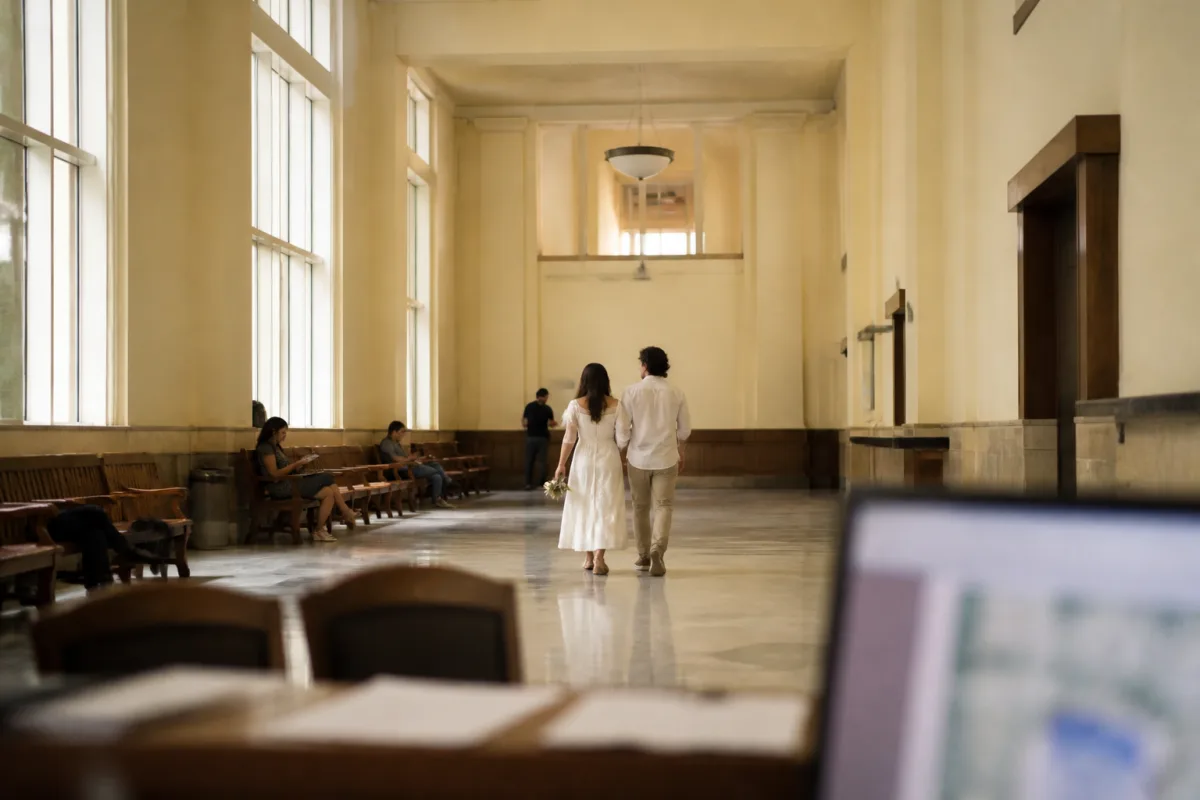
The standard package — photos, lease, accounts — is just as easy for scammers to reproduce as for real couples. Value lies in what’s hard to invent: contractor correspondence, medical agreements, a stepparent’s role in a child’s school records.
Why the Decision Rests on the Whole Picture, Not One Document
USCIS can’t verify the authenticity of every document submitted — not a lease, not photos, not a letter with an organization’s stamp. In theory, anything can be forged: photos get edited with AI, and a letter with an institution’s logo can turn out to be a plain Word file. That’s why an officer’s decision on an I-130 petition rests not on one piece of paper but on the totality of the circumstances, together with how the spouses present themselves at the interview.
In practice, a marriage interview runs roughly 20 to 40 minutes — and in that time, the officer has to decide whether the marriage is real. There’s no way to verify a single document’s authenticity in that window, but inconsistencies in a couple’s story at the interview stand out immediately. That’s why the evidence package matters not on its own, but as part of the overall picture the officer builds from the documents and from a personal impression of the couple.
a marriage interview runs roughly 20 to 40 minutes — and in that time, the officer has to decide whether the marriage is real
Frequently asked questions
Can you file an I-130 petition if the spouses married recently and don’t have much shared history yet
The source material doesn’t directly address a minimum marriage length for filing I-130, but the logic of unique evidence suggests: the shorter the relationship’s history, the fewer natural ‘traces’ of shared life — correspondence, trips, shared events — a couple will have. That doesn’t make filing impossible, but it increases the weight placed on whatever has already accumulated, and on how the couple comes across at the interview.
Can you file I-130 without photos if, for some reason, none were kept
Photos are the strongest argument, but not the only one: an officer’s decision is based on the totality of the circumstances and the couple’s behavior at the interview, not on a single document. Without photos, it’s worth relying on other types of evidence — correspondence, joint accounts, trips, or unique evidence like a contractor dispute or a significant event in the couple’s life.


Comments
Reader experience is useful, but it is not advice: check the rules on the official site.
No account needed: click Sign in, type any name, and you are done.